査読反論レター(Rebuttal Letter)書き方とテンプレート
査読反論レター(Rebuttal Letter)は、論文採択を勝ち取るための最も重要な書類の一つです。的確な反論と丁寧な同意のバランスが採否を左右します。このガイドでは、すぐに使えるテンプレートと豊富なフレーズ集で、採択につながる反論レターの書き方を完全解説します。
・Rebuttal Letterの定義・目的・使用タイミング
・基本構成と各セクションの役割
・すぐに使える完全テンプレート(日本語解説付き英語)
・同意・反論・部分同意のフレーズ集(計25例)
・統計的指摘への反論フレーズ
・避けるべき表現と代替案
・提出前チェックリスト
1. Rebuttal Letterとは何か・いつ書くか
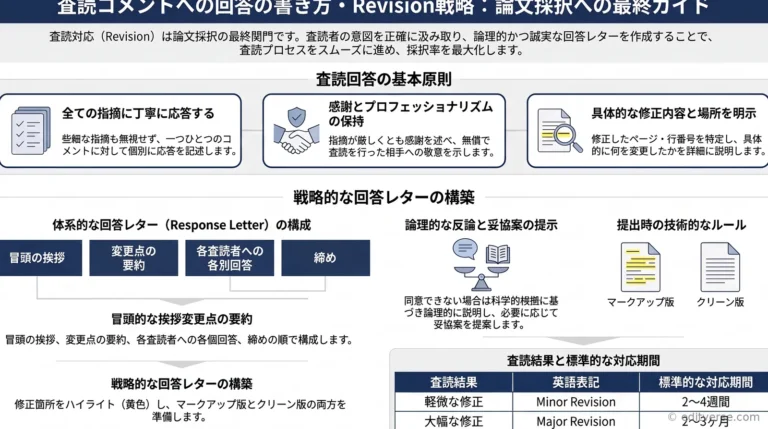
Rebuttal Letter(リバタル・レター)とは、査読者のコメントに対して著者が行う正式な回答書面です。日本語では「査読回答書」「査読反論レター」などとも呼ばれます。
Rebuttal Letterを書くタイミング
| 状況 | エディターからの通知 | Rebuttal Letterの役割 |
|---|---|---|
| Minor Revision(軽微な改訂) | 「改訂を推奨」 | 全コメントへの回答+改訂箇所の説明 |
| Major Revision(大幅な改訂) | 「大幅な改訂が必要」 | 詳細な回答+反論の根拠提示 |
| リジェクト後の再投稿 | 「不採択だが再投稿可」 | 前回の問題点を解決したことを示す |
| 別ジャーナルへの投稿 | (新規投稿) | 前ジャーナルの問題点を解決済みと説明 |
Rebuttal Letterは改訂した論文(Revised Manuscript)と同時に提出します。「レターで言及した修正」が実際に論文に反映されているかを査読者が照合するため、両者の一致が必須です。
2. Rebuttal Letterの基本構成
| セクション | 内容 | 長さの目安 | 重要度 |
|---|---|---|---|
| 冒頭挨拶 | 感謝の表明、改訂の概要 | 1〜2段落 | |
| 全体サマリー | 主要な変更点の一覧 | 箇条書き5〜10項目 | |
| Reviewer 1への回答 | コメントを引用し、逐一回答 | コメント数による | |
| Reviewer 2への回答 | 同上 | コメント数による | |
| 締め・署名 | 感謝と今後の協力の意思表明 | 1段落 |
3. 完全テンプレート(日本語解説付き英語テンプレート)
【冒頭挨拶】Opening Section
Dear Dr. [Editor’s Name],
We are grateful for the opportunity to revise our manuscript entitled “[Manuscript Title]” (Manuscript Number: [XXX]). We sincerely appreciate the time and effort invested by the Editor and the reviewers in providing their thorough and constructive comments.
We have carefully considered all the comments and have revised the manuscript accordingly. Below, we provide a point-by-point response to each comment. For clarity, the reviewers’ original comments are shown in italics, followed by our responses. All changes made to the manuscript are highlighted in blue text in the revised version.
【日本語解説】冒頭では必ず感謝を述べ、レターの構成(コメントを斜体で引用すること、変更箇所をハイライトすること等)を予告します。
【全体サマリー】Summary of Major Changes
Summary of Major Changes:
In response to the reviewers’ comments, we have made the following major revisions:
1. [Major change 1 — e.g., Added sensitivity analysis (Supplementary Figure S3)]
2. [Major change 2 — e.g., Expanded the Discussion section to address limitations]
3. [Major change 3 — e.g., Revised the statistical analysis using [method]]
4. [Major change 4]
5. [Major change 5]We believe these revisions have substantially strengthened the manuscript, and we hope they will address the concerns raised by the reviewers.
【日本語解説】エディターと査読者が最初に目を通す重要なセクションです。主要な変更を箇条書きで簡潔にまとめ、論文が実質的に改善されたことを示します。
【Reviewer別回答】Point-by-Point Response
—
RESPONSE TO REVIEWER 1
—We thank Reviewer 1 for the thoughtful and constructive comments, which have helped us to significantly improve the manuscript.
Comment 1:
[Paste Reviewer 1’s Comment 1 here verbatim]
Response:
We thank the reviewer for this important point. [Your response here]. We have revised the manuscript accordingly. Specifically, [describe the exact change made]. This can be found on page [X], line [Y] of the revised manuscript.Comment 2:
[Paste Reviewer 1’s Comment 2 here verbatim]
Response:
[Your response to Comment 2]—
RESPONSE TO REVIEWER 2
—We thank Reviewer 2 for the detailed and insightful feedback.
Comment 1:
[Paste Reviewer 2’s Comment 1 here verbatim]
Response:
[Your response to Comment 1]
【日本語解説】各コメントを逐字引用(斜体)した後に「Response:」として回答を書きます。改訂箇所のページ・行番号を明記することで査読者の確認作業を助けます。
【締め】Closing Section
We hope that the revised manuscript and our responses to the reviewers’ comments are now satisfactory. We believe the revisions have substantially improved the quality and clarity of the manuscript.
We are grateful for the constructive feedback and the opportunity to revise our work. We look forward to hearing from you regarding the outcome of this revision.
Yours sincerely,
[Corresponding Author’s Name]
[Institution]
[Email]
[Date]
反論レターの英語表現で自信がない方へ
EditVerse Japanのネイティブエディターが、査読コメントへの的確な英語表現に仕上げます。採択を勝ち取る反論レター作成を全面サポートします。
4. 同意する場合の定型フレーズ集(10例)
査読者のコメントに同意し、修正を行った場合に使用するフレーズです。同意の表現は丁寧かつ具体的に。
| # | 英語フレーズ | 使用場面 |
|---|---|---|
| 1 | We thank the reviewer for this insightful comment and fully agree with this assessment. | 完全同意・全面修正 |
| 2 | This is an excellent point. We have revised the manuscript accordingly on page [X]. | 重要な指摘への同意 |
| 3 | We agree that this information was missing from the original manuscript. We have now added [X] in the Methods section (page [X], line [Y]). | 情報不足の指摘への同意 |
| 4 | We appreciate this valid concern. In the revised manuscript, we have clarified [X] to address this point. | 曖昧さの指摘への同意 |
| 5 | The reviewer raises an important point. We have corrected this error and have now [describe correction]. | 誤りの指摘への同意 |
| 6 | We fully accept this suggestion and have incorporated it into the revised manuscript. | 提案への全面受諾 |
| 7 | We concur with the reviewer’s assessment. The relevant paragraph has been rewritten to reflect this. | 評価への同意と書き直し |
| 8 | This is a fair criticism. We have added [X] to address this limitation, as described on page [X]. | 限界の指摘への同意 |
| 9 | We thank the reviewer for pointing this out. We have now included [X] as requested. | 追加要求への同意 |
| 10 | The reviewer is correct that [X]. We have updated [section] accordingly to improve clarity. | 記述の不明確さへの同意 |
5. 反論する場合のフレーズ集(10例)
査読者のコメントに科学的根拠をもって異議を唱える場合のフレーズです。礼儀正しくしながらも主張を明確に。
| # | 英語フレーズ | 使用場面 |
|---|---|---|
| 1 | We respectfully disagree with this assessment. As shown in [reference/data], [your argument]. | 基本的な反論 |
| 2 | While we appreciate the reviewer’s perspective, we believe that [your position] is more appropriate for the following reasons: [reasons]. | 代替案を提示しての反論 |
| 3 | We would like to respectfully maintain our original interpretation, as it is consistent with the findings reported by [Author, Year, PMID: XXXXX]. | 先行研究を根拠とした反論 |
| 4 | Although we understand the reviewer’s concern, we believe the current approach is justified because [scientific rationale]. | 方法論への反論 |
| 5 | We appreciate this comment; however, implementing the suggested change would alter the fundamental scope of the study, which is beyond the aims of this paper. | 研究スコープ外の要求への反論 |
| 6 | We respectfully note that the data requested by the reviewer are not available due to [specific reason], which is a recognized limitation of this study type. | 実現不可能な要求への反論 |
| 7 | We believe there may be a misunderstanding of our methodology. To clarify: [explanation]. | 誤解に基づくコメントへの反論 |
| 8 | With respect, we disagree that [reviewer’s claim]. Our data clearly show [your evidence], and this finding is supported by [citation]. | データに基づく強い反論 |
| 9 | We appreciate the reviewer’s concern; however, [proposed change] would introduce [specific problem], which could undermine the validity of our findings. | 要求の採用が問題を生じる場合 |
| 10 | We have carefully considered this suggestion; however, we maintain that [your approach] is the most rigorous method for addressing [specific question], as recommended by [guideline/reference]. | ガイドライン・方法論を根拠とした反論 |
6. 部分的に同意する場合のフレーズ集(5例)
査読者の指摘の一部は受け入れるが、全面的には同意できない場合の表現です。
| # | 英語フレーズ | 使用場面 |
|---|---|---|
| 1 | We partially agree with the reviewer’s concern. We have addressed [aspect 1] by [change], but respectfully maintain our position on [aspect 2] because [reason]. | 部分的な同意と部分的な反論 |
| 2 | We agree that [specific point] needed clarification. However, we do not believe that [the broader change suggested] is warranted, as [reasoning]. | 一部の変更を受け入れる場合 |
| 3 | The reviewer raises a valid point about [X]. We have revised [Y] to address this concern. With respect to [Z], however, we believe the original approach remains appropriate. | 一部同意・一部維持 |
| 4 | We appreciate this suggestion and have incorporated it with some modifications. While we have [what you did], we were unable to [what you couldn’t do] because [reason]. | 修正付きの受け入れ |
| 5 | We have taken this comment seriously and revised [section] to better reflect [X]. However, we feel that completely [suggested change] would go beyond the scope of the current study. | スコープを理由とした部分的な受け入れ |
7. 統計的指摘への反論フレーズ
統計的な手法・解釈に関する指摘は特に慎重な対応が必要です。
・使用した統計手法の選択根拠を明示する
・選択の根拠となるガイドライン・教科書・文献を引用する
・必要に応じて感度分析を追加して頑健性を示す
・統計専門家に確認済みであることを示すことも有効
We respectfully maintain our use of [statistical method]. This approach is consistent with the guidelines established by [statistical authority/reference], and has been validated in previous studies (e.g., [Author, Year, PMID: XXXXX]). To further address the reviewer’s concern regarding the robustness of our findings, we have added a sensitivity analysis using [alternative method] in Supplementary Figure S[X]. The results are consistent with our primary analysis, supporting the validity of our approach.
統計解析の詳細な報告方法については、論文における統計解析結果の報告方法もご参照ください。
8. 避けるべき表現と代替案
| 避けるべき表現(NG) | 問題点 | 推奨される代替表現(OK) |
|---|---|---|
| “The reviewer is wrong about…” | 攻撃的・非専門的 | “We respectfully disagree with this point because…” |
| “As we already stated in the manuscript…” | 査読者を批判するように聞こえる | “We apologize for the lack of clarity. We have revised [section] to make this point clearer.” |
| “This comment is irrelevant to our study.” | 否定的・非礼 | “While we appreciate this comment, we believe it falls outside the scope of the current study, which focuses on…” |
| “We have done what the reviewer asked.” | 具体性がなく不十分 | “We have addressed this by [specific action]. The revised text now reads: ‘[quote revised text].'” |
| “This is impossible.” | 根拠のない拒否 | “Unfortunately, this analysis is not feasible within the scope of this study because [specific reason]. However, we have added this as a future direction in the Discussion (page X).” |
| “No changes were made.” | 説明不足 | “After careful consideration, we have decided to maintain the original text. Our rationale is as follows: [explanation].” |
| “The reviewer misunderstood our paper.” | 査読者を責める表現 | “We apologize that our original description was unclear. We have revised [section] to more clearly explain [point].” |
9. 提出前チェックリスト
| チェック項目 | 確認 |
|---|---|
| 全ての査読コメントに回答しているか(1つも抜けがないか) | □ |
| 査読者のコメントを正確に引用しているか | □ |
| レターで言及した全ての変更が論文に反映されているか | □ |
| ページ番号・行番号の参照が正確か | □ |
| 攻撃的・否定的な表現が含まれていないか | □ |
| 変更箇所が論文内でハイライト(追跡変更)されているか | □ |
| 引用文献のPMID・DOI等が正確か | □ |
| 英語の文法・スペルチェックを行ったか | □ |
| 提出期限内に間に合うか | □ |
10. 関連記事
- 査読コメントへの回答の書き方【完全ガイド】
- リバイス期限の延長依頼(英文メール例文)
- 実現不可能な追加実験への回答例(実データ付き)
- リジェクト対応完全ガイド
- 採択率を高めるアブストラクトの書き方
- 論文カバーレターの書き方
統計に関する指摘は、文章の修正では解決しません
「多変量モデルで交絡を調整してください」「正規性の前提が確認されていません」——こうした指摘は、解析そのものをやり直す作業です。再解析、再現可能なRスクリプト、修正版の図表、統計コメントへの回答文までを一括で対応します。定額¥98,000、アクセプトまで修正回数無制限。
回答レター作成から統計の再解析まで、採択まで定額で
査読コメントの分析、回答レター(Response to Reviewers)、改訂原稿の英文校正、必要に応じた統計の再解析まで対応します。論文1本¥29,800から、納品後のお支払い・公費対応。
11. 参考文献・根拠となる研究
- Baxt WG, Waeckerle JF, Berlin JA, Callaham ML. (1998). Who reviews the reviewers? Feasibility of using a fictitious manuscript to evaluate peer reviewer performance. Ann Emerg Med. PMID: 9737492
- Kravitz RL, Franks P, Feldman MD, et al. (2010). Editorial peer reviewers’ recommendations at a general medical journal. PLoS One. PMID: 20386704
- Bornmann L, Mutz R, Daniel HD. (2010). A reliability-generalization study of journal peer reviews: a multilevel meta-analysis of inter-rater reliability and its determinants. PLoS One. PMID: 21179459
- Tomkins A, Zhang M, Heavlin WD. (2017). Reviewer bias in single- versus double-blind peer review. Proc Natl Acad Sci U S A. PMID: 29138317
採択を勝ち取る反論レターをプロと一緒に
EditVerse Japanのネイティブエディターと専門家チームが、査読回答レターの作成から英文校正まで全面サポート。多くの著者が採択を実現してきた実績があります。